Have you ever picked up your own product and thought that the label simply does not look right? Maybe the colours are dull. Maybe the text is not clear. Or perhaps the sticker begins to peel off after some days.
Many Indian businesses have this as one of their problems. A good product may still appear cheap without proper printing of the label. And customers make a decision about your brand in seconds, and it may be just a look at the label. Here, you will be informed in this blog on the meaning of label printing, how it is done, why it is important, and how you can go about selecting the appropriate label printing method to apply to your product. At the end, you will be certain of how to achieve labels that will appear clean, professional, and trustworthy without spending time and money.
What is Label Printing?
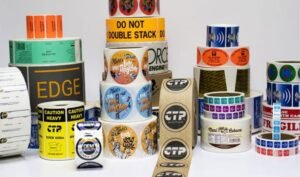
The making of stickers, tags, or roll labels for products is called Label printing. Labels are made of paper, plastic, clear, or metal-look. These labels carry important text, logos, barcodes, and safety information that is very helpful for the customers. Different machines and methods blend to print labels. Some use inkjets, others use special rolls and plates. Each way gives a different speed, cost, and finish.
Why Label Printing Matters for Indian Small Businesses
Good label printing builds trust, and bad labels look cheap. That can make you lose customers. In India, labels also need to handle humidity and heat. So print quality and material choice matter.
- Labels help sell your product.
- They show brand names and product details.
- They help with legal rules like the listing of ingredients.
- Barcodes and batch numbers make selling and stock easy.
Common Label Printing Methods
Here are the main ways printers make labels:
- Digital printing: Good for small runs and many designs with fast proofing. Best for colourful short jobs.
- Flexographic (Flexo): Uses plates and rolls, great for long runs and low cost per label. Good for food labels and bottles labels.
- Offset printing: Very sharp images for large orders. Good when colour match matters.
- Thermal printing: Used for shipping and barcodes. Works with a barcode printer and special labels.
- Screen printing: Thick ink, good for special effects like metallics.
Common Problems and Mistakes To Avoid
Here are the main ways printers make labels:
Wrong size or unreadable text
- Problem: Small fonts or a busy layout.
- Fix: Keep text bigger than 6–7 pt and use simple fonts.
Bad colours or no proof
- Problem: Colour on screen printed colour.
- Fix: Ask for a printed sample (proof) first.
No barcode or bad barcode quality
- Problem: Scanners fail.
- Fix: Use a thermal or industrial barcode printer and test the barcode.
Choosing the wrong printer company
- Problem: Cheap quotes but bad quality.
- Fix: Check samples, lead time, and past clients. See the section below on choosing a label printing company.
How to choose a label printing company in India
If you are in India and want trusted help, Prakash Label can guide you on materials and samples. Use their experience to pick the right option for your budget and product.
- Ask for samples
Look at finished labels for similar products. A real sample tells you the print quality.
- Check the materials they use
Do they offer waterproof films, glossy or matte finishes, and UV coatings?
- Check machines and methods
For small runs, digital is fine. For big runs, flexo or offset may be cheaper. Ask which they recommend for your order size.
- Ask about barcode printing
If you need barcodes, ask if they can print and test them or if you should use a separate barcode printer.
- Check lead time and MOQ
Small brands often need a low MOQ. Some companies can do small rolls.
- Read reviews and talk to other brands
A good label printing company will show past clients and reviews.
Step-by-step: How to order labels
- Budgeting and Quantity: Always keep in mind that small runs cost more per piece, rather than the big runs cost less per piece.
- Choose material: Choosing the material matters, like Paper for dry goods, plastic for wet or oily products. Clear for glass.
- Choose the printing method: the method of printing is needed much, digital for short runs, flexo/offset for long runs.
- Design the label: Always keep the labels clean, use large text for key info. Leave the crop and bleed area.
- Keep barcode and batch number: Ask the printer to test the barcode or use a barcode printer for in-house labels.
- Get a printed proof: Check the colour and finish on the real sample.
- Confirm lead time and shipping: Get the delivery date and packaging method.
- Place the order: Keep one sample for quality checks when you receive the full batch.
Simple Scenarios
These examples show how choices change by product and quantity. If unsure, ask your label printer for a recommendation.
- Small home-made jam brand
Need 200 labels, Use digital printing on glossy paper. Low cost, bright colours. Order a sample first.
- Bottled shampoo brand
Need 10,000 labels, use flexo on polypropylene. Waterproof and cheap per piece.
- Retail items with barcodes
Print the main label and use a barcode printer for price tags or logistics labels.
Conclusion
Label printing is simple when you follow a plan. Pick the right material. Choose the correct printing method. Test your barcodes. Ask for samples. If you need help, talk to a trusted label printing company like Prakash Label. They can show samples and give a clear quote.
FAQs
1. How much does label printing cost?
Cost depends on size, material, colours, and run length. Small runs cost more per label. Big runs lower the per-label price.
2. What is the fastest way to get a small label order?
Use digital printing, which needs less setup and a faster proof time.
3. Can I print barcodes on my labels?
Yes, you can add barcodes to the label design. For tough or high-speed scanning, use a dedicated barcode printer or ask the printer to test the barcode.
4. How do I pick a label printing company?
Ask for samples, check materials, ask about MOQ and machines, and read reviews. Trust companies that show real samples and case studies.
5. What is the minimum order size?
It varies; some digital printers do 50–100 labels. Flexo usually has higher minimums. Always ask.
6. Do labels need a special design file?
Yes, Printers like PDF or AI files with bleed and the correct size. But many printers can help if you only have a simple image.