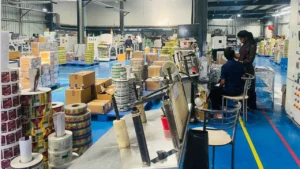


In a typical industrial setting, with numerous operations going on, you cannot afford to miss out on key details. Even the label used for industrial machines or equipment cannot be taken lightly, in fact it has a very important role to play in managing and protecting your business. Labels for machines may feel like a small detail, but it is key to streamlining your operation. From regulatory compliance, worker safety, to operational efficiency, everything is connected to right labeling techniques.
To avoid issues such as non-compliance, unclear prints, and inferior label materials, it is advisable to go with custom RFID labels. Such labels are primarily selected for industrial machines due to their superior features. RFID labels help automate data capture that does not need a direct line of sight. Where traditional barcodes and labels lack in dealing with harsh environments or real-time tracking, RFID technology can withstand rough environments, accurately track equipment data usage, and read bulk RFID labels at once.
In today’s digital era, RFID or Radio Frequency Identification technology is recognized as a critical tool for industrial inventory management, operational automation, and product traceability. With years of experience in providing RFID label solutions, Prakash Labels offers best-quality RFID tags and labels created using advanced manufacturing techniques. Such high-end techniques ensure unmatched durability, performance, and accuracy, as every tag is customized to meet the demands of its environment. RFID tags are considered as perfect labels for machines.
RFID tag working principle involves use of wireless radio waves to send and receive data. RFID tags act like a touch-free mechanism. A reader will send out specific radio waves for finding the RFID tags. When a tag is detected in the vicinity, it gets powered on and transmits certain stored data to that reader. This reader receives the data and sends it to a computer system.
To explain an RFID system, you have to understand that it is made of three critical elements. A standard RFID label is designed out of three elements, each amplified with special bonding and converting procedures. This ensures good quality and tough resilience. These elements form the technological core of the RFID tag, enabling wireless contact and 100% traceability. There are basically three parts:
RFID Chip – It acts like a brain, storing data and managing active communication with the reader. With diverse memory and security features, the chips adapt to basic as well as advanced applications. This progression allows high traceability, regulatory compliance, and complying to other operational demands.
Antenna – The antenna has the ability to trace the energy of the advanced electromagnetic field sent out by the reader and interpret the signals. The antenna is devised to give optimum range and good efficiency, even with other interferences and presence of certain metals.
Support Material – A substrate is used to bind and protect the chip as well as the antenna. Using tough materials that are put to exhaustive bonding processes to create a strong and durable bond, even in rough industrial conditions.
Industrial machines require something more durable and sturdier than normal barcode stickers. Machinery and industrial equipment are always exposed to harsh conditions, extreme temperatures, potent chemicals, and hefty vibrations. RFID technology and systems are a necessity in such an environment. RFID labels for machines boost industrial progression through automation of services, no-contact tracking, real-time traceability, long-lasting durability, and enhanced inventory management in rough conditions.
Check out the widest range of RFID software, hardware, and consumables made available by Prakash Labels. You can request for custom RFID labels for your projects. RFID tags enable quick identification of assets and improved efficiency of the entire operational system.
What is RFID technology?
RFID or Radio Frequency Identification is a modern wireless technology, which applies radio waves to track and locate assets or people and automatically identify them. It is popularly used in industrial settings for inventory management, collection of toll, contactless dealings, and access ID cards.
Can RFID labels work successfully on metallic surfaces?
On-metal RFID labels or tags can catch RF signals. Such tags use specialized spacer backing to avoid the antenna interference away from the metal surfaces.
Do RFID labels withstand tough factory environments?
Yes, RFID labels for machines are designed to withstand industrial and factory floor conditions such as extreme environments and heavy vibrations. They are known as hard tags or smart labels and are carefully designed with industry-grade materials to resist extreme temperatures, chemicals, UV rays, and more.
Where can I purchase the best quality RFID printers?
You can consider RFID printers by Prakash Labels. These are high-quality printers capable of printing labels and writing tags. They offer consistent printing even in tough industrial environments with superior tracking abilities and real-time visibility.
What are the uses of RFID software?
RFID software can help run your business by tracking assets and managing inventory. It offers seamless, customer-centric support, and near-perfect solutions based on high-tech RFID systems.Prakash Labels RFID software helps in encoding systems for bulk printing and labeling of RFID tags. Additionally, it also offers automatic inventory systems, interactive display systems, loss-prevention systems, and complex cloud-based tools for streamlined supply chain visibility and tracking current stock levels.
Can my smartphone read RFID tags?
All modern devices like smartphones are enabled with NFC or Near Field Communication, which can easily read HF RFID labels or tags.
Also Read: