Search “label printers in Noida” and you will get two kinds of company presented identically: converters who own presses, and traders who take your order and place it with someone who does.
Both have websites. Both have product galleries. Only one of them controls your lead time, your colour consistency and your ability to pass a customer audit.
Telling them apart is the single most useful skill in this purchase, and it takes about four questions. This guide covers those questions, what the print technologies actually mean for your job, and which certifications matter for which industry.
Nothing wrong with brokers as such. But if your labels are going onto a regulated product, into an export carton or onto a production line running at speed, the distance between you and the press matters.
“Which press will my job run on?” A converter answers with a machine — a flexo line, a digital press, the width, the number of colour stations. A broker answers with a description of the output.
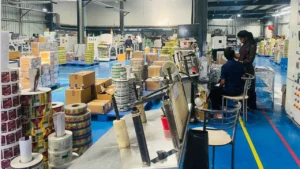
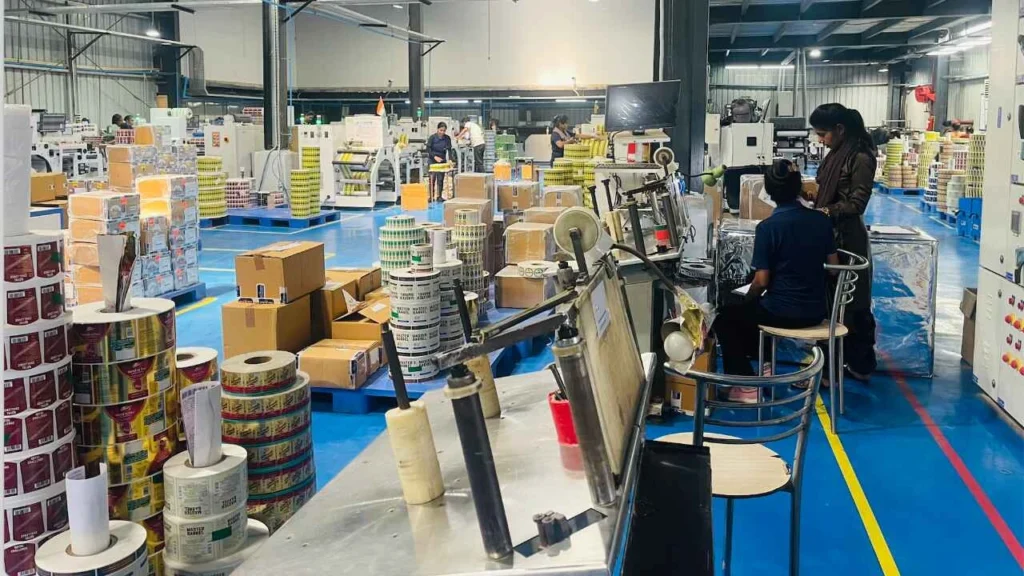
“Can I visit during my run?” Converters say yes and mean it. This is also the fastest way to see whether the plant matches the website.
“What is your in-house finishing capability?” Die-cutting, lamination, cold foil, varnish, slitting, rewinding, inspection. Work that leaves the building for finishing adds days and hands off quality control.
“Show me your last three inspection reports for a job like mine.” A converter has them. This question ends more conversations than the other three combined.
The print technologies, and what each is actually for
Most buyers ask for a price before they have settled the process, which is backwards, because the process determines what is possible and what a change will cost later.
| Process | Best for | Setup cost | Per-unit cost at volume | Variable data |
| Flexography | Long runs, consistent artwork | High | Lowest | No |
| Digital | Short to medium runs, versions | Very low | Higher | Yes |
| Offset | Very high quality, long runs | High | Low | No |
| Screen | Heavy ink lay-down, opacity | Moderate | Moderate | No |
| Thermal | In-house, on-demand printing | Lowest | Depends on labelstock | Yes |
The practical decision usually comes down to two things. If you have many SKUs or short runs, digital removes plate costs and lets you print versions economically. If you have a stable design and volume, flexo will beat digital on unit cost, and the plate cost amortises.
The trap is version count. A brand with fourteen variants and a modest annual volume per variant often prices flexo on total volume and then discovers the plate charge applies per variant. Ask for pricing per SKU, not per thousand labels in aggregate.
Thermal deserves a separate note because it is a different purchase entirely. If you are printing dispatch labels, batch codes or weigh-price labels in your own facility, you are buying blank labelstock plus a printer, not a printed label. The specification that matters there is the labelstock — direct thermal versus thermal transfer, topcoated or not — and the ribbon.
This is where the buying decision stops being about price.
Food and beverage. When choosing stickers for food packaging, it is important to ensure that the materials and inks meet applicable regulations. Under India’s Food Safety and Standards (Packaging) Regulations 2018, printing inks used on food packages must conform to IS 15495, the Indian Standard code of practice for printing ink for food packaging. That is a real, checkable requirement, and a supplier should be able to state ink compliance without hesitation. Your pack also has to carry the declarations required by the Legal Metrology (Packaged Commodities) Rules 2011 — manufacturer or importer name and address, country of origin, generic name, net quantity, month and year of manufacture or packing, MRP inclusive of all taxes, and consumer-care contact details including email and telephone.
Pharmaceutical. Rule 96 of the Drugs Rules 1945, amended by G.S.R. 823(E) of 17 November 2022, required a QR code or barcode on the top 300 drug brands listed in Schedule H2 from 1 August 2023. Reporting on a further amendment in June 2026 indicates Schedule H2 is being extended from named brands to whole categories — vaccines, narcotics and psychotropics, and anticancer drugs from July 2027, with antimicrobials following in July 2028. Confirm the current position against the gazette notification before you build a specification around it, but if you print pharma labels, this is the change to be watching.
Agrochemicals and hazardous goods. GHS labelling requires six elements — pictograms, signal word, hazard statements, precautionary statements, product identifier and supplier identification. If the goods travel by sea, BS 5609 applies, and it is worth understanding properly because it catches buyers out.
Section 2 certifies the base material, the facestock and adhesive combination, tested through artificial weathering, temperature cycling and three months of seawater immersion. Section 3 certifies the printed image — the inks, ribbons and print system applied to that material. Changing your printer or ribbon can invalidate a Section 3 certificate even though the labelstock is unchanged. Note that the 2024 revision of BS 5609 separated the two sets of requirements so they can now be passed individually, and added HDPE as a mandatory test surface alongside aluminium.
Export, whatever the product. If your labels go onto goods bound for the EU, food-contact compliance runs through Regulation 1935/2004 and the GMP regulation 2023/2006, with printing-ink compliance evidenced by a Declaration of Compliance from your labelstock and ink suppliers. Ask for the DoC at quotation stage. Suppliers who have it produce it immediately; suppliers who do not will offer reassurance instead.
If a quotation gives you a rate per thousand and nothing else, it is a price, not a specification. Ask for these in writing:
1. The full material construction: facestock, adhesive and liner, named individually. “White paper label” is one third of a specification, and not the third that fails.
2. Print process and colour count, including any special colours, and whether they are process-matched or spot.
3. Finishing: die shape and size, lamination or varnish, foil, and whether the die is existing or new. New dies carry a one-time cost.
4. Roll format: core diameter, outer diameter, labels per roll, wind direction. Get this wrong and the labels will not run on your applicator.
5. Tolerances: dimensional and registration.
6. MOQ and lead time, stated separately for new jobs and repeats.
7. Ink compliance statement where the labels touch food, pharma or children’s products.
8. Sample and approval process: who signs off, on what, and at what stage.
Item 4 is the one that produces the most expensive surprises. A perfectly printed label wound the wrong way round is scrap on an automatic applicator.
Proximity is not a sentimental argument in this category, it is an operational one.
Label supply is iterative. Artwork changes, a shade needs adjusting, a substrate behaves differently on the line than on the sample, an urgent batch needs a re-run. Each of those is a same-day conversation with a supplier forty minutes away and a week-long email chain with one in another state.
Delhi NCR also concentrates the relevant industry: pharmaceutical and medical device manufacturing in the Noida and Faridabad belt, agrochemicals, automotive components, FMCG and a very large e-commerce fulfilment footprint. A converter working across those sectors has already solved the substrate and compliance problems your job presents.
Prakash Labels has been manufacturing labels from Sector 85 in Noida for over thirty years, supplying customers including Flipkart, Hero, Yazaki, Hindustan Syringes & Medical Devices and Willowood Crop Science — a spread that runs from e-commerce dispatch through automotive components to medical devices and crop protection, which are four quite different substrate and compliance problems.
How do I choose between flexo and digital printing for labels?
Volume and version count. Digital avoids plate costs and suits short runs and many variants; flexo has a higher setup cost but a lower unit cost at volume. Ask for pricing per SKU rather than on aggregate volume, because plate charges usually apply per design.
What is the minimum order quantity for custom labels?
It varies by process and by supplier, and digital MOQs are typically far lower than flexo. Ask for MOQ and lead time separately for a new job and for a repeat, since the two are usually different.
What certifications should a label supplier have?
It depends on the product. Food packaging requires ink compliance to IS 15495 under the FSS Packaging Regulations 2018. Export to the EU requires a Declaration of Compliance for food-contact applications. Marine-shipped hazardous goods require BS 5609. General quality management certification is a reasonable baseline for any regulated supply.
How long do custom printed labels take?
Lead time depends on whether a new die and new plates are needed, on material availability and on approval cycles. The honest answer any supplier can give is a range plus the list of things that extend it — ask for both.
Can I get a printed sample before ordering?
Yes, and you should. Ask for the sample on the actual material and process being quoted, not on a house stock, and test it on your own container and your own line.
What is the difference between a label converter and a label trader?
A converter owns and operates the presses. A trader takes the order and places it elsewhere. Ask which press your job will run on and whether you can visit during production.
Before you request a quotation
Do one thing first: write down the substrate your label is going onto, the temperature range it will live through, and whether it will be wet. Those three facts determine the material, and the material determines the price more than the printing does.
Bring that to any supplier, in Noida or elsewhere, and the conversation moves straight to specification. If you would like a spec discussed against your actual container and line, the Prakash Labels team in Noida will work through material, process and format before quoting.
This article is general information for buyers of printed labels and is not a specification or a compliance opinion. Regulatory requirements differ by product category, destination market and packaging format, and change over time; the position described here reflects sources available in August 2026. Confirm the requirements applicable to your product with the relevant authority or a qualified compliance adviser before relying on them.