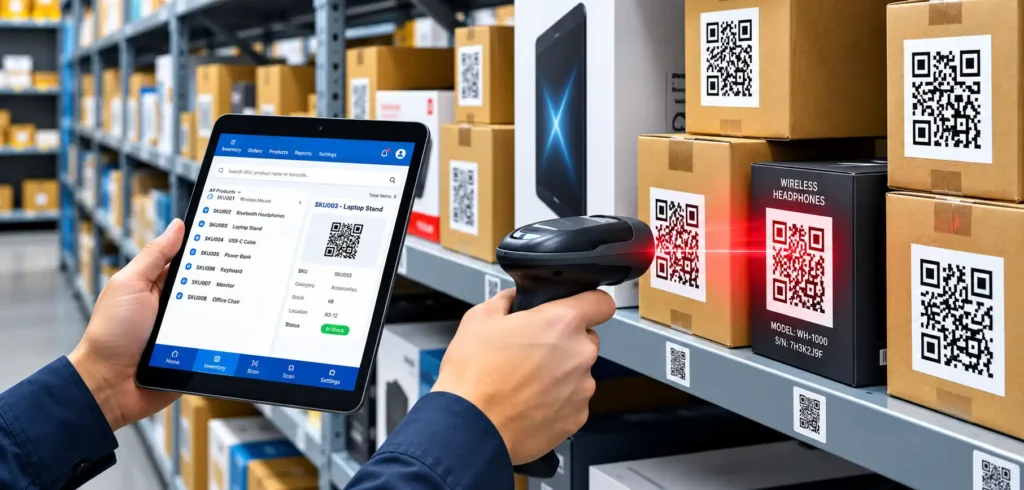
2D barcode scanning improves inventory management because one scan picks up everything you need to know about a product, not just its code. The item number, batch, expiry date, serial number, even the quantity in the carton can all sit inside a single 2D barcode. Your store-keeper presses the trigger once and it’s in the system. No retyping batch numbers off a smudged sticker, no guessing. That means fewer mistakes, quicker inward and dispatch, stock figures you can actually trust, and recalls you can trace to one batch.
Of course, it isn’t magic. How much you gain depends on what you stock, how your labels are printed and what scanner your people are holding. A 2D code on a pharma carton and a 1D code on a cement bag are doing very different jobs. The results come when the code, the label and the scanner get planned together, not bought one at a time.
So in this guide we’ll walk through what changes on the floor once you switch, how a 1D and a 2D barcode scanner compare, where Data Matrix comes in, and a few mistakes we keep seeing that eat into the benefits.
Think of a normal 1D barcode as a single line of text. Bars and gaps, read left to right, and usually all it holds is a short product number that points to a record somewhere in your software. A 2D barcode uses height as well as width. It’s a small grid of black and white squares, and because data runs both ways, it can fit hundreds (sometimes a few thousand) characters into a patch smaller than a postage stamp.
For anyone running a stockroom, that difference is bigger than it sounds. The 1D code can only say “this is product X”. Batch, expiry, which supplier lot it came from? Somebody has to type it in or hunt for it. With a 2D barcode, all of that is printed right there on the label. It goes wherever the box goes, including to a distributor whose system has never heard of yours.
And there’s error correction built in. A Data Matrix can usually be read even with about 30% of it damaged, which is a relief when cartons get dragged, restacked and shrink-wrapped three times before they reach a shelf. You’ll mostly run into four types: QR Code, Data Matrix, PDF417 and Aztec.
The 1D vs 2D barcode scanner question really comes down to how each one reads. A 1D scanner (laser or linear imager) sweeps one line across the bars. A 2D barcode scanner works more like your phone camera. It snaps an image of the whole code, and software decodes it. Because it’s reading a picture, it handles 1D and 2D codes alike, at any angle, and it can even read a code off a mobile screen. A laser can’t.
| Factor | 1D barcode scanner | 2D barcode scanner |
| How it reads | Laser line or linear sensor | Camera-style area imager |
| Codes it reads | Linear only (EAN, UPC, Code 128) | Linear and 2D (QR, Data Matrix, PDF417) |
| Scan angle | Must line up with the bars | Any orientation |
| Scratched or smudged labels | Often fails | Usually recovers the data |
| Codes on screens | Cannot read | Reads easily |
| Upfront cost | Lower | Slightly higher |
Is a 1D scanner ever enough? Sometimes. If every item you handle has only linear codes and batch or expiry tracking isn’t on your roadmap, it’ll do the job. But that’s getting rare. Most Indian manufacturers and distributors now get stock from suppliers using a mix of codes, and pharma, FMCG and auto parts are all shifting to 2D. Buy a 1D unit today and there’s a fair chance you’ll be replacing it within a couple of years. Our barcode scanner range covers handheld, cordless and fixed-mount 2D imagers if you want to compare.
Not quite, and people mix these up all the time. “2D barcode” is the whole family; Data Matrix is one member of it. Asking 2D barcode vs Data Matrix is a bit like asking vehicle vs truck. Every Data Matrix is a 2D barcode, but so is a QR code, a PDF417 and an Aztec code.
A Data Matrix is easy to recognise once you know what to look for: a solid L-shaped border running along two of its sides. It squeezes data in tighter than a QR code does, which is why you’ll find it on medicine vials, circuit boards and metal parts etched right on the production line. QR codes carry more data in total, and phone cameras read them without any fuss.
Our rule of thumb for inventory? Data Matrix (ideally the GS1 DataMatrix standard) for internal tracking, tiny parts, healthcare products and anything where batch and expiry have to be recorded for compliance. QR codes wherever a customer, dealer or service engineer is going to scan with a phone. Plenty of brands print both on one pack, and that’s perfectly fine.
One date worth keeping in mind. GS1’s Sunrise 2027 initiative wants retail checkouts around the world reading GS1 DataMatrix and QR codes alongside regular barcodes by the end of 2027. That’s only about a year away now, so if you’re redesigning packaging or labels this year, factor it in.
Picture a carton arriving at your inward dock. Someone checks the item code, the batch number and the expiry against the PO. With 1D codes, that’s one scan plus two rounds of typing, and honestly, typing is where most stock errors start. One 2D scan sends all three fields into your ERP or WMS together. On a heavy inward day, checking that used to eat up the whole afternoon gets done before lunch.
Since the expiry date lives inside the 2D barcode, your system can enforce first-expiry, first-out picking without anyone squinting at printed dates. If a picker grabs a pack expiring in March while one expiring in January is still on the rack, the system flags it on the spot. For food, cosmetics and pharma businesses, that alone saves a lot of stock from expiring unnoticed at the back of a shelf.
Say a supplier recalls one batch. In a warehouse running only 1D codes, the usual move is to block the entire SKU, because separating batches by hand takes far too long. With 2D, you scan, filter by batch number and pull out just the affected units. India’s Schedule H2 rule follows the same thinking. QR codes or barcodes became mandatory on the top 300 medicine brands from August 2023, and in June 2026 the government extended this, in phases, to antimicrobials, vaccines, cancer drugs and narcotic medicines.
Labels take a beating. Shrink-wrap tears, ink smudges, a forklift scrapes past. A laser scanner gives up and somebody ends up keying the code in by hand. A 2D barcode scanner, with error correction and image-based reading on its side, will usually read it anyway, so your cycle counts don’t stall.
Spare parts, jewellery, electronic components, ampoules. Most of these never had room for a 1D barcode, so they got counted by hand (and, often enough, counted wrong). A Data Matrix just a few millimetres across fits without trouble, so those items can finally be scanned and tracked like the rest of your stock.
Imagers don’t care which way a carton is facing, so nobody has to turn boxes around to line up the bars. Extended-range models can read labels on the top racks from the floor. Once scanning is this quick, regular cycle counts stop feeling like a chore, and you’re not stuck with one exhausting stock-take every March.
Don’t just go for the priciest model on the list. The right 2D barcode scanner is the one that matches where and how your people actually work. A few things to check before you buy:
That last one trips up a lot of buyers. Even an expensive scanner struggles with a faded thermal label printed on the wrong stock. Plan your labels, ribbons and printer at the same time as the scanner, not as an afterthought.
When a 2D rollout disappoints, it’s rarely the scanner’s fault. More often, the business treated it like swapping one gadget for another, when what’s really changing is how data moves through the whole operation. The usual culprits:
Run a two-week pilot on the product line that gives you the most trouble. It’ll bring most of these problems to the surface while they’re still cheap to fix.
The reason 2D barcode scanning improves inventory management is simple enough: the important information sits on the item, so every scan tells the whole story. What it is, which batch, when it expires, where it came from. If you’re unsure where to begin, begin small. Choose the product line where mistakes hurt most (usually short-expiry or recall-prone stock), add a 2D code with batch and expiry, hand that team a 2D imager and watch the numbers for 30 days.
For over 30 years, Prakash Labels has worked with manufacturers, pharma companies and distributors across India on labelling and Auto ID. Barcode printers, labels, ribbons, every kind of barcode scanner, we handle all of it. Tell us about your floor, your software and your budget, and we’ll help you plan a 2D setup that actually fits.
Yes. It uses an imager that captures the whole code, so it reads linear barcodes like EAN, UPC and Code 128 just as easily as QR codes and Data Matrix. That’s a big reason most businesses replacing old scanners go for 2D now.
Not exactly. A QR code is one type of 2D barcode; Data Matrix, PDF417 and Aztec are others. QR codes work best when people scan with phones, while Data Matrix suits small items and regulated products.
Usually not by much. A 2D scanner costs a little more than a 1D model, but the real effort goes into label design and getting your software ready. That’s exactly why a small pilot before the full rollout pays off.
In most sectors, no law says you have to. Still, food, FMCG, auto parts and retail all gain from tracking batch and expiry. And with GS1 Sunrise 2027 coming up, planning now beats a rushed changeover later.