A shopper in a Noida supermarket gives your product about three seconds before their hand moves to the next brand. In that window, the label does most of the selling. For fast-moving consumer goods, custom FMCG labels are the quickest, cheapest lever a brand has to win attention, stay compliant, and protect margin — cheaper than reformulating a product and faster than buying more ad space.
India’s FMCG sector is the country’s fourth-largest, and it is still expanding: NielsenIQ data reported by IBEF put recent quarterly volume growth at 6.4%, with rural demand now driving close to 45% of value. More packs, more variants, and more first-time buyers reach the shelf every quarter. The label is where all of that competition gets decided.
Custom FMCG labels matter because they carry four jobs at once: they sell the product at the shelf, they build brand recall, they satisfy Indian labelling law, and they defend against counterfeits. A generic off-the-shelf sticker does one of those jobs. A purpose-built label does all four, which is why spec-driven brands treat their FMCG product labels as a business asset, not artwork.
The evidence for the selling job is direct. A national survey by the Paper and Packaging Board and IPSOS found 72% of consumers say packaging design influences their purchase decision, and 64% have tried a new product simply because the packaging caught their eye. For an FMCG brand fighting for a slot on a crowded modern-trade gondola, that is the difference between a pick-up and a walk-past.
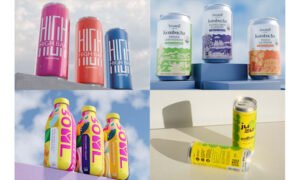
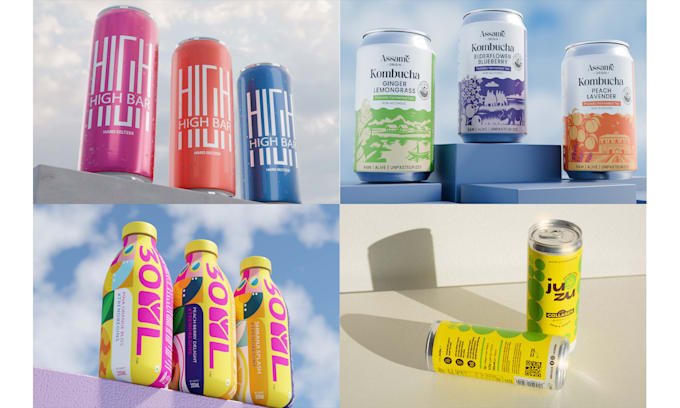
Shelf appeal labels win the eye with finish, colour fidelity, and shape — the things a plain white sticker cannot deliver. Metallic foils, spot gloss over matte, tactile textures, and clear-on-clear “no-label” looks make a pack read as premium from two metres away, before the shopper can even read the name.
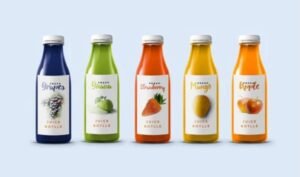
Colour consistency is the unglamorous half of shelf standout. When the same SKU prints a slightly different red across three production runs, the brand block on the shelf breaks up and recognition drops. Prakash Labels‘ FMCG line is built on tight colour control and ISO- and GMP-certified production precisely so a brand’s red stays the same red across 20,000 or 100,000 units. Cosmetics and personal-care brands lean on foil stamping and embossing; staples and household lines lean on bold, legible colour blocks. The right choice depends on the category and the competitor set, not on a template.
Yes — and for FMCG this is often the real reason to go custom. A single flavour range can run to a dozen variants, each needing its own colour, its own barcode, and its own batch and expiry data. Custom label printing lets a brand keep one design system while changing the variable fields, so the family looks coherent but every unit is individually traceable.
This is where labels meet Auto ID. Variable-data printing drops unique batch numbers, MRP, manufacturing dates, and QR codes onto each label in-line, using thermal-transfer wax or resin ribbons that survive handling. Prakash Labels ran exactly this kind of serialisation for Hindustan Syringes & Medical Devices, where every shipping carton’s unique barcode links back to the tertiary, secondary and primary serial numbers uploaded to the government’s dava.gov.in track-and-trace portal. FMCG brands use the same capability for recall readiness, warehouse scanning, and consumer-facing QR campaigns.
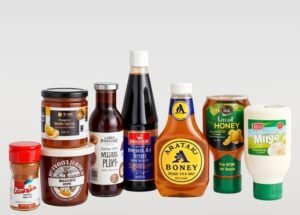
This is the benefit most generic label buyers underestimate. Indian FMCG packaging now carries legal obligations that the label itself has to display. Food packs must meet FSSAI declaration rules; recycled plastic packaging must be marked under BIS standard IS 14534:2023, and compostable packaging must carry the line “compostable only under industrial composting” per IS/ISO 17088:2021.
Extended Producer Responsibility (EPR) makes this sharper. Under the CPCB’s plastic packaging framework, packaging is sorted into Category I (rigid), II (flexible films and sachets), III (multi-layered), and IV (compostable), with recycling targets for rigid formats climbing to 70% and beyond over the next cycles. Brand owners increasingly need labels that support recyclability claims and recycled-content marking — which is why material choice and eco-friendly, recyclable-compatible label stocks are now a compliance decision, not just a sustainability gesture. Getting the label wrong here is not a design problem; it is a regulatory exposure.
A custom label can carry security features that a copyist cannot easily reproduce, and in Indian FMCG that matters more than most brands admit. FICCI’s CASCADE work has estimated that roughly 30% of FMCG products sold in India are counterfeit or fake, with the sector among the highest revenue losers to illicit trade. Every fake unit is a lost sale and a dented reputation.
Tamper-evident and anti-counterfeit constructions close that gap: VOID and destructible films that shred on removal, holographic and metallic security layers, hidden QR authentication, and serialised codes that let a consumer verify a pack before buying. Because these features are built into a custom label rather than added later, they are cheaper to run at volume and far harder to strip and reuse.
The right material is the one that survives your product’s journey — from a humid warehouse to a chilled display to a shopper’s bag. Below is a practical starting map for matching label stock to FMCG use.
Label material or finish | Best-fit FMCG application | Why it works
Coated paper (gloss or matte) | Dry foods, biscuits, staples, home-care cartons | Low cost at high volume, sharp print, easy for large SKU ranges
BOPP / PP film | Beverages, sauces, personal care, chilled packs | Waterproof, oil- and moisture-resistant, survives condensation
Clear-on-clear (no-label look) | Premium cosmetics, craft beverages | Transparent, premium branded packaging labels with shelf standout
Metallic, foil or holographic | Festive and premium SKUs, security packs | Shelf appeal plus a built-in anti-counterfeit layer
Thermal-transfer (wax or resin ribbon) | Batch, MRP, date and QR variable data | Prints unique data in-line, scans reliably across the supply chain
Tamper-evident / destructible film | Sealed food, security-sensitive FMCG | VOID or destructs on removal, deters refill and counterfeit fraud
Eco-friendly / recyclable-compatible stock | EPR-conscious and export brands | Supports recycled-content and compostable labelling claims
Durability is the test that fails quietly. A label that looks perfect in the artwork PDF can peel, smudge or fade by the time it reaches a Tier-2 kirana shelf. When Paytm’s earlier labels peeled off the glass doors of shops under wide temperature swings, Prakash Labels re-engineered a construction that held its grip through the heat and cold, at an optimised cost, because for high-volume FMCG the per-unit price of the fix has to stay tiny. Branded packaging labels have to earn their keep on both fronts: look right, and stay stuck.
Custom printing turns the label into a campaign tool. Limited editions, festival packs, contest and cashback codes, and QR-driven activations all live on the label, and they can be produced in short runs without re-tooling the whole pack. That lets a brand test a promotion in one region before rolling it national.
Speed is the differentiator at launch. When Willowood Crop Science found its labelling was not connecting with buyers, a custom screen-label solution rebuilt the shelf appeal and the customer connect that repeat business depends on. FMCG launches live or die on retail-ready dates, and a label partner that delivers ahead of a tight deadline — as Prakash’s FMCG clients repeatedly note — is worth more than one that is merely cheap. Cost still matters, and custom labels for FMCG brands reward scale: set-up is amortised across the run, so unit economics improve as volumes climb from 20,000 into the lakhs.
For an Indian FMCG brand in 2026, the label is doing marketing, compliance, traceability and security work simultaneously, and the brands that win the shelf are the ones that spec it that deliberately. Match the material to the journey, build in variable data and security from the start, and keep colour and durability consistent across every run.
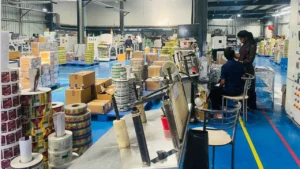
Prakash Labels brings 30-plus years and an ISO- and GMP-certified plant in Sector 85, Noida to exactly that problem, across food, beverage, personal care, home care and promotional FMCG lines. To pressure-test your current label spec or plan a launch run, request a quote and talk to the Prakash Labels team.
What is the minimum order quantity for custom FMCG label printing in India?
It varies by material and print process, but FMCG runs typically start around 20,000 units and scale to 100,000-plus. Custom labels reward volume: set-up costs are spread across the run, so the per-label price drops as quantities rise. Prakash Labels handles both pilot batches and bulk production.
How do custom labels carry batch numbers, MRP and QR codes?
Through variable-data printing. Fixed brand artwork is printed once, while batch codes, manufacturing and expiry dates, MRP and unique QR codes are added per unit using thermal-transfer ribbons. This keeps every pack individually traceable and scan-ready for warehouses, recalls and consumer verification.
Which label material is best for chilled or moisture-heavy FMCG?
Film stocks such as BOPP or PP outperform paper for beverages, frozen foods, sauces and personal care, because they resist water, oil and condensation and hold adhesion through temperature swings. For cold-chain products, the adhesive choice matters as much as the face stock.
Do custom FMCG labels have to follow EPR and BIS rules?
Yes. Recycled plastic packaging must be marked per BIS IS 14534:2023, compostable packaging per IS/ISO 17088:2021, and plastic packaging falls under the CPCB’s EPR categories. Food packs also follow FSSAI declaration norms. A spec-driven label partner builds these requirements in rather than bolting them on.
How quickly can labels be produced for a product launch?
Turnaround depends on material, finishing and quantity, but experienced FMCG suppliers plan around retail-ready dates and can accelerate for launches. Prakash Labels’ FMCG clients regularly cite on-time or early delivery on launch runs as a reason for repeat business.