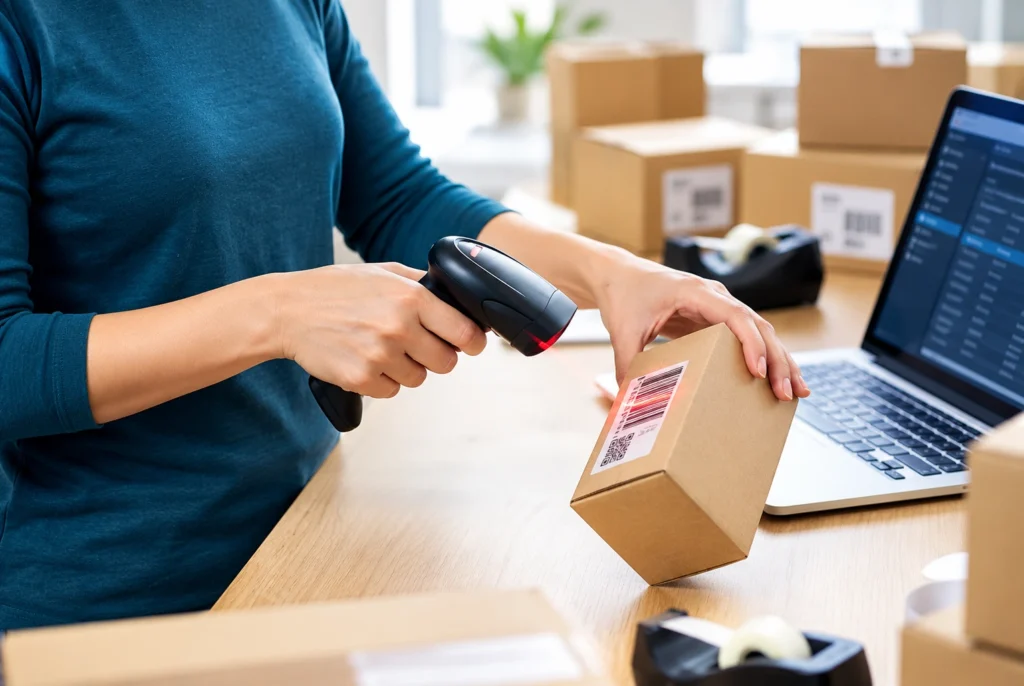
Barcode verification means checking a printed barcode against ISO and GS1 quality standards and giving it a grade, normally from A (4.0) down to F (0.0). It’s done with a barcode verifier, a device that measures contrast, how sharp the bar edges are, print defects and the blank margins around the code. The grade tells you if the code will scan at every point in the supply chain. Not just on the scanner next to your printer. For most GS1 barcodes, anything under a C (1.5) counts as a fail.
Why does this matter? We’ve seen barcodes beep perfectly on the packing table and then get rejected at a retailer’s DC. Their scanners might be older. Faster. Working under bad warehouse lighting. A verifier isn’t interested in whether one scanner got lucky. It checks whether the code is printed well enough that any scanner should read it.
If you print labels in-house, sell through modern trade or ship export orders, verification is cheap insurance next to the cost of one rejected consignment. In this guide we’ll cover how grading works, what GS1 asks for, how to choose a barcode verification scanner, and the printing problems that pull grades down.
We get asked this a lot. Short answer: no. When a normal scanner reads your barcode, it’s only saying “I decoded it, this once.” Today’s scanners are built to be forgiving. Weak contrast, a slightly thick bar, a tight margin: they’ll push through and beep anyway. Brilliant for billing counters. Pretty much useless as a quality check.
A verifier does something else entirely. It shines a controlled red light (660 nm) on the code, reads it through a fixed-size aperture and compares the result to a published standard. You don’t get a yes or no. You get a grade for each parameter, plus an overall grade. And a code sitting at D may well scan today, then fail next month once the ribbon wears a bit or you switch label stock.
Somewhere in between sits what people call barcode checking, or print quality monitoring. Cameras on the print line grade codes as they’re printed, so drift gets caught early. It’s useful. But unless that setup itself meets the verifier standards (ISO/IEC 15426-1 for 1D, 15426-2 for 2D), those numbers aren’t a formal verification grade.
Grading isn’t somebody eyeballing a label. Three ISO standards spell it out. ISO/IEC 15416 covers linear (1D) barcodes, ISO/IEC 15415 covers printed 2D codes such as QR and Data Matrix, and ISO/IEC TR 29158 covers codes marked straight onto metal or plastic. Every genuine verifier follows them, so two different brands should give you roughly the same grade.
The verifier takes at least ten scan lines at different heights across the bars. Each line has three hurdles first. It has to be decoded. The bars have to be dark enough (minimum reflectance). And every bar-to-space edge needs enough contrast. Only then is the line scored on symbol contrast, modulation, defects and decodability. Its weakest score becomes that line’s grade, and all ten get averaged. Since the 2016 update, grades go to one decimal place, so instead of a plain B, your report might say 2.7.
2D codes are graded from one image, and in one respect they’re tougher. There’s no averaging. The single weakest parameter is the final grade. Apart from decode and symbol contrast, the verifier looks at modulation, fixed pattern damage (the finder pattern and quiet zone), and axial and grid nonuniformity, which reveal stretching or warping. It also checks unused error correction, which shows how much of the code’s repair capacity has already been eaten up.
| Letter | Numeric grade | What it means in practice |
| A | 3.5 to 4.0 | Excellent; reads first time almost anywhere |
| B | 2.5 to 3.4 | Good; small room for improvement |
| C | 1.5 to 2.4 | Acceptable; usual GS1 minimum |
| D | 0.5 to 1.4 | Risky; may need repeated scans |
| F | below 0.5 | Fail; expect rejections |
Reports often show something like 2.8/06/660. Read it as three parts: the grade, the aperture in thousandths of an inch, and the light wavelength in nanometres. A grade quoted without the aperture and light is, honestly, missing half the story.
ISO explains how to measure a barcode. GS1 decides what score is good enough to trade with. So GS1 barcode verification is basically ISO grading with some extra rules added, all written into the GS1 General Specifications that retailers, distributors and hospitals worldwide follow.
The number to remember is 1.5, a C grade. That’s the floor for most GS1 symbols, the EAN-13 on a retail pack included. For a standard retail EAN or UPC, GS1 writes it as 1.5/06/660: at least 1.5, measured through a 6 mil aperture under 660 nm light. Shipping carton codes like GS1-128 and ITF-14 have separate aperture and size rules. So does GS1 DataMatrix on medicines.
A good print grade still isn’t the full pass, though. GS1 verification also looks at things a print score can’t. Is the barcode the right size for where it’ll be scanned? Tall enough? Does the data follow GS1 syntax, with the right check digit and correctly formatted application identifiers for batch, expiry and so on? We see plenty of labels that print beautifully and fail anyway, because the data inside is built wrong.
A small tip from experience. When a buyer asks for a verification report, confirm the grade and aperture they expect before testing. A few big retailers want B or above on everything, just to leave room for wear in transit.
A barcode verification scanner looks a bit like a handheld reader or a small desktop camera, but inside it’s a measuring instrument. Ordinary barcode sprakashlabelscanners are built to read; a verifier is built to judge, using fixed lighting, a known aperture and calibrated optics. That’s also why it costs more and needs looking after.
There are three types you’ll run into most. The first is a handheld or desktop verifier. It stays near the printer or in the QC room, and someone pulls a few labels from every batch to test by hand. Inline verifiers are fixed onto the printer or packing line and grade each label that passes, handy when volumes are high. Then there’s the DPM verifier, with special lighting for codes etched or dot-peened onto metal and plastic.
When you compare models, a few things matter more than the brochure suggests:
That last point gets ignored more than it should. A verifier that hasn’t been calibrated in a year can hand you a confident grade that’s simply wrong.
Nine times out of ten, a poor grade comes from the label, the ribbon or the printer settings, not the barcode design itself. The good news is that a verification report usually points straight at the cause, if you know how to read it.
Ribbon and label pairing deserves a special mention. A wax ribbon that works fine on paper labels can smear on synthetic stock, and the grade drops even though nothing else changed. If grades slip mid-run, check consumables before you blame the printer.
Barcode scanning accuracy isn’t decided at the moment of scanning. It’s mostly decided at the printer, weeks earlier. A label that leaves your unit at a borderline grade gets rubbed in a truck, stacked in a humid godown and squinted at by a scanner in bad light. By the time it reaches the retailer’s receiving dock, that borderline C has quietly become a D.
What happens then is rarely dramatic, just expensive. Staff scan twice, then type the number in by hand, and manual entry is exactly where wrong SKUs and wrong quantities creep into stock records. In modern trade and e-commerce fulfillment, unreadable cartons can be set aside, relabelled at your cost or sent back. For pharma, where a GS1 DataMatrix carries batch and expiry, a code that won’t read can hold up an entire shipment.
Regular verification breaks that chain early. Grading a few samples from every batch, and logging the results, shows you when quality starts drifting, long before a customer notices. Over time those logs also become proof. If a buyer ever disputes your labels, a dated verification report is a far stronger answer than “it scanned fine here.”
Barcode verification takes the guesswork out of label quality. Instead of hoping a code will scan at the other end, you get a grade measured against the same ISO and GS1 rules your buyers use. The businesses that get the most from it don’t treat it as a one-time test before launch. They verify the first label of every run, spot-check through the batch and recheck whenever the ribbon, label stock or artwork changes.
Prakash Labels has been working on labelling and Auto ID for more than 30 years, with manufacturers, pharma companies and exporters across India. If your barcodes keep getting flagged, or you’d simply like to know where you stand before a buyer asks, our team can help you look at your labels, ribbons and printing setup together.
For most GS1 barcodes, a C (1.5) is the minimum pass. Aim for B (2.5) or better, though, so the code still reads after handling and transport wears it down a little.
No. Phones and normal scanners can only tell you whether a code decodes. Proper barcode verification needs controlled lighting, a fixed aperture and calibrated optics, which only a conforming verifier provides.
No. Linear barcodes are graded under ISO/IEC 15416, printed 2D codes under ISO/IEC 15415, and directly marked parts under ISO/IEC TR 29158. All three use the same A to F scale.
At the start of every print run, and again whenever something changes: new label stock, new ribbon, new artwork or printer maintenance. High-volume lines are better served by inline verification.