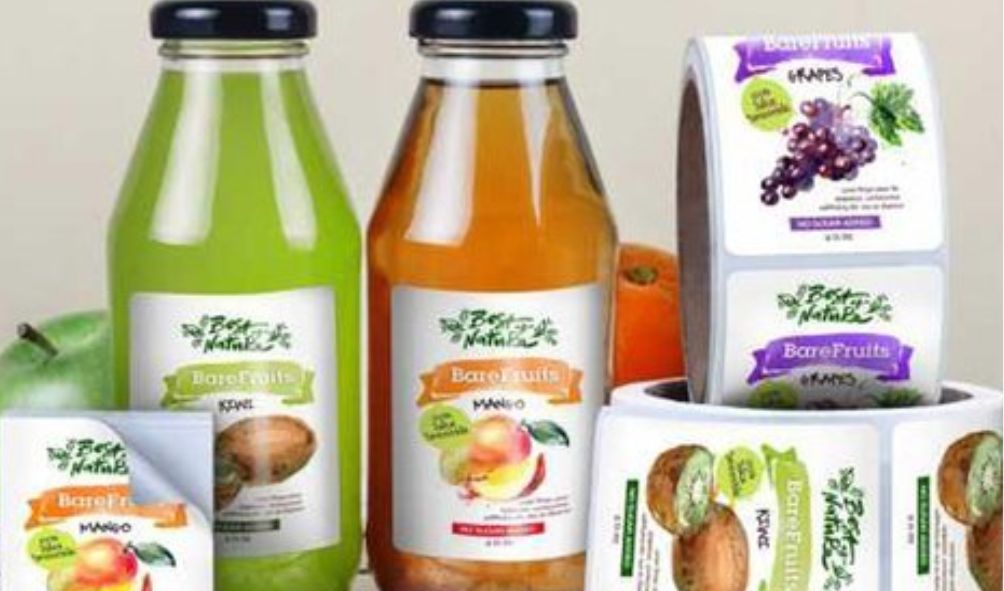
A beverage label has one job your packaging line cannot afford to get wrong: stay legible, stuck, and compliant from the filling head to the consumer’s hand. Beverage labeling is the engineering discipline of matching a label’s material, adhesive, and print process to a specific drink type, its container, and the conditions it survives, from a chilled juice bottle sweating in a retail fridge to a beer can pulled from an ice bucket. Get the spec right and the label sells the product. Get it wrong and you are reprinting an entire run, or worse, failing an FSSAI inspection.
Most label guides stop at listing materials. This one maps the spec to the beverage, because a label that performs flawlessly on a room-temperature water bottle can curl off a frozen dairy drink within hours. At Prakash Labels, a 30+ year label manufacturer based in Noida, we have built beverage label runs for FMCG and D2C brands across exactly these failure points, and the pattern is always the same: the brand chose the look first and the spec last.
The single biggest cause of beverage label failure is moisture, and not the obvious kind. The threat is condensation, the film of water that forms on a cold container the moment it leaves refrigeration and meets warm air. This is the cold-chain problem, and it punishes the wrong adhesive choice harder than rain ever could.
Here is the mechanism. A pressure-sensitive label relies on an adhesive bond. When a bottle is filled cold or chilled after filling, condensation can keep that adhesive from ever fully setting, and adhesive that never sets will lift at the edges, then peel. Industry packaging engineers are blunt about it: pressure-sensitive adhesive can disintegrate or begin to peel when submerged in water or stored in cold temperatures (per PDC and CTM Labeling Systems guidance). A shrink sleeve, by contrast, uses no adhesive at all. It is a printed plastic film heat-shrunk to the container, so condensation has nothing to break.
We saw this exact dynamic with Paytm. Their QR labels were peeling off the glass doors of shops that swung between hot exteriors and air-conditioned interiors all day. Our team engineered a label that held through those temperature swings at an optimised cost. The lesson transfers directly to beverages: the environment, not the artwork, decides whether your label survives.
Different drinks impose different physics on a label. Below is how we spec each category. Treat it as a starting brief, not a catalogue.
Beverage Type | Primary Challenge | Recommended Label and Adhesive | Why
Packaged drinking water | High clarity, low cost, high volume | Clear-on-clear pressure-sensitive (BOPP), or shrink sleeve for 360-degree branding | Water bottles rarely face deep cold; the priority is a premium “no-label look” at scale
Juice and RTD beverages | Condensation in retail fridges, pasteurisation heat | Wet-strength PP with a wet-apply or cold-temperature adhesive, or shrink sleeve | The label must survive both the hot fill or pasteurisation and the cold display case
Carbonated soft drinks | Pressure, fast lines, condensation | Shrink sleeve or pressure-sensitive BOPP with high-tack adhesive | High-speed filling and chilled display demand a label that will not flag at the edges
Alcohol (beer, spirits, wine, RTD) | Ice-bucket immersion, premium feel, FSSAI ABV rules | Wet-strength paper or metallised PP for spirits; shrink sleeve for cans | Beer cans get submerged in ice; spirits need a tactile premium finish that resists scuffing
Dairy and dairy-based drinks | Deep cold, freeze-thaw, short shelf life | Cold-temperature or freezer-grade adhesive on PE or PP face stock | Adhesive that works at 4 degrees can fail at minus 18; the spec must match the coldest point in the chain
Face stock. Paper looks craft and premium but wicks moisture unless it is a treated wet-strength grade. Film stocks, polypropylene (PP) and polyethylene (PE), shrug off water and conform to squeezable bottles. For anything that lives in a fridge or an ice bucket, film is the safer default.
Adhesive. This is where brands lose money. A standard permanent adhesive is rated for room-temperature application. If you apply or store the product cold, you need a cold-temperature or wet-apply adhesive, and on a wet line you may also need an air knife to dry the container before labelling. Condensation created after filling can stop a standard adhesive from setting at all.
For beverages specifically, the choice between a shrink sleeve and a pressure-sensitive label is the most consequential spec decision after adhesive. Shrink sleeves win on three beverage-critical fronts: they are immune to condensation because they use no adhesive, they wrap 360 degrees for full-container branding and can double as a tamper-evident cap band, and they hug contoured or non-cylindrical bottles that a flat label cannot.
Pressure-sensitive labels win on cost per unit for simple cylindrical containers, on short runs and quick design changes, and on that clean “no-label” transparent look for premium water and spirits. Our broader take on durable, waterproof construction applies here: if the product spends real time wet or cold, a film face stock with the right adhesive, or a sleeve, is not the premium option, it is the correct one.
The honest rule: if your beverage spends hours in a cold, wet, or contoured environment, lean shrink sleeve. If it is a cylindrical, ambient or lightly chilled product where unit cost and design agility matter, pressure-sensitive is the smarter spend.
For any beverage sold in India, the label is a legal document before it is a marketing asset. FSSAI rules for 2026 changed meaningfully, and the alcohol segment in particular has a hard deadline.
The headline change: FSSAI extended the enforcement date for new labelling requirements on alcoholic beverages from 1 January 2026 to 1 July 2026 (per the FSSAI compendium and Bar and Bench analysis). Note the split. The product standards, composition and quality parameters, came into force on 1 January 2026, but the labelling provisions were pushed to 1 July 2026. The extension came because mid-year label changes collided with state excise registration cycles that reset on 1 April or 1 July, which would have forced brands to scrap and reprint already-registered labels.
What every beverage label must still carry under FSSAI: the standard or descriptive product name (a product with under 10% fruit content must say “fruit drink”, not “fruit juice”), net quantity, manufacturer details, date of manufacture, and best-before date. For alcohol, alcohol content must be declared as percentage ABV or as proof, and FSSAI now defines a standard drink as one containing 12.7 ml of ABV measured at 20 degrees Celsius.
The practical takeaway for brand owners: if you sell alcoholic RTDs, beer, wine or spirits, your labels must reflect the new requirements by 1 July 2026. Reprinting a compliant label is far cheaper than a recall. Build the regulatory copy block into the artwork now, and confirm your label material can carry the added text legibly at the size your container allows.
A Pre-Production Checklist Before You Approve a Beverage Label
The coldest and wettest point the product will face, then spec the adhesive to that point, not to room temperature.
Whether the container is filled hot, cold, or ambient, since this drives adhesive setting.
Whether the bottle is cylindrical or contoured, which decides sleeve versus flat label.
That every FSSAI-mandated element fits legibly, including the 1 July 2026 alcohol rules where relevant.
A condensation trial: chill a labelled sample, leave it to sweat, and check edge lift at 24 and 72 hours.
That last step is the cheapest insurance in packaging. A 50-rupee trial run prevents a 50,000-rupee reprint.
What is the best label material for cold drink bottles?
For bottles that face condensation and refrigeration, use a film face stock such as polypropylene or polyethylene with a cold-temperature adhesive, or a shrink sleeve, which uses no adhesive and is immune to moisture. Paper labels need a treated wet-strength grade to survive a cold, damp environment.
Are shrink sleeves better than stickers for beverages?
For cold, wet, or contoured bottles, shrink sleeves usually perform better because they have no adhesive to fail and wrap the full container. Pressure-sensitive labels (stickers) are more cost-effective for simple cylindrical bottles, short runs, and frequent design changes.
What does FSSAI require on a beverage label in 2026?
FSSAI requires the product name, net quantity, manufacturer details, date of manufacture, and best-before date. Alcoholic beverages must declare ABV or proof and comply with new labelling requirements enforced from 1 July 2026, with a standard drink defined as 12.7 ml of ABV at 20 degrees Celsius.
Why do beverage labels peel off in the fridge?
Because condensation forms on the cold container and prevents a standard pressure-sensitive adhesive from setting, causing edge lift and peel. The fix is a cold-temperature or wet-apply adhesive, drying the container before labelling, or switching to an adhesive-free shrink sleeve.
Can one label work for water, juice, and alcohol?
Rarely. Each beverage imposes different demands, water prioritises clarity and cost, juice and dairy face deep cold, and alcohol has ice immersion plus FSSAI ABV rules. Spec each product line to its own conditions rather than reusing one material across the range.
Spec the Conditions, Not Just the Look
The brands that never call us about peeling labels are the ones that specced for the coldest, wettest moment their drink will face, then chose the artwork. Reverse that order and you are gambling a full production run on room-temperature assumptions. With the 1 July 2026 FSSAI alcohol deadline approaching, this is the season to audit every beverage SKU’s label against both its physical environment and the new rules.
Prakash Labels has spent 30+ years matching label material, adhesive, and print process to the specific drink, container, and supply chain in front of us, from packaged water to spirits. If you are launching a beverage line or reprinting for compliance, talk to our team about a condensation trial and an FSSAI-ready spec before you commit to a run.