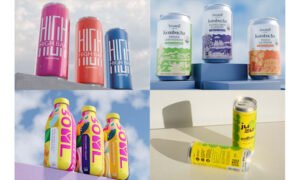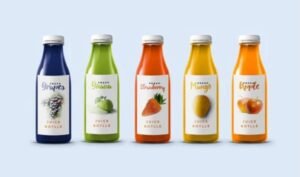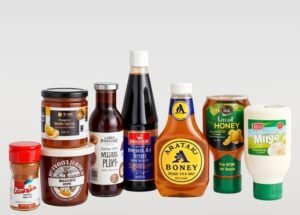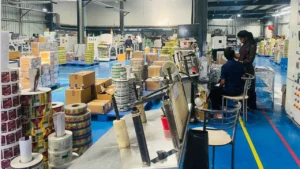
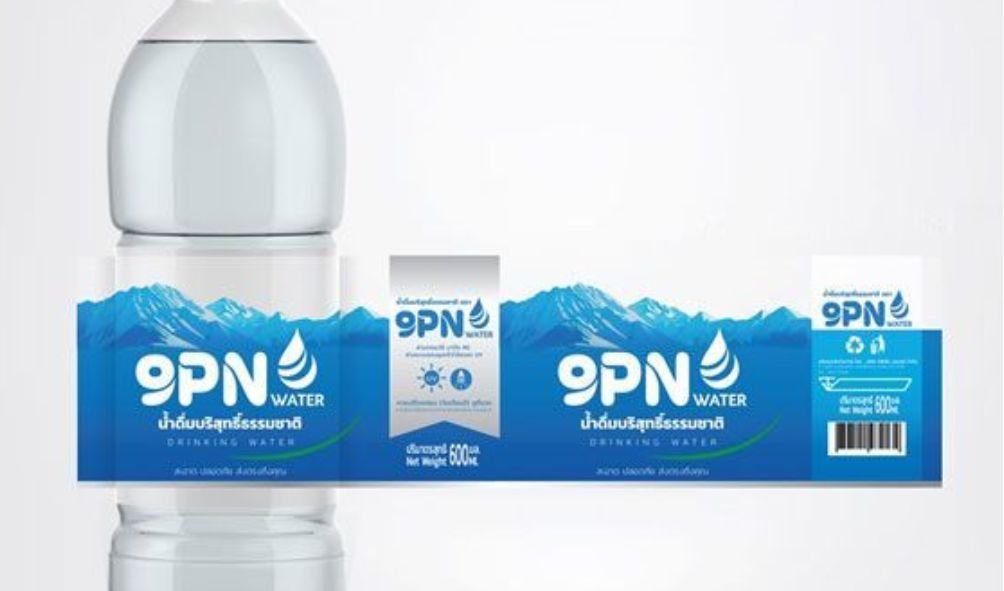
Bottle labeling is the process of choosing a face material, adhesive or sleeve, and printing method that keeps a label readable and stuck through the conditions a bottle actually faces refrigeration, condensation, handling, and an FSSAI inspection. Get the spec right and the label survives the cold chain get it wrong and edges lift on the first chilled pallet. This guide is written for procurement and packaging managers who have to defend that spec.
Most “bottle labeling” pages online are storefronts that sell you a sticker before asking what the bottle goes through. That gap is the reason a label that photographed beautifully in the design proof peels off a sweating water bottle in a Delhi summer warehouse. The decision that matters is not the artwork. It is matching material and application method to the failure mode — and, in India, staying inside the FSSAI Labelling and Display Regulations while you do it.
Prakash Labels has been printing for the food, beverage, and liquor segments for over 30 years, and one of its documented case studies — a label for Paytm that kept peeling off the glass doors of shops — was solved precisely by re-engineering the material to survive temperature swings at an optimised cost. That is the lens this guide uses throughout.
For most chilled or moisture-exposed beverage bottles, the right face material is BOPP (biaxially oriented polypropylene). It takes on close to zero percent moisture, resists oil and UV, and bonds to glass, PET, and metal — which is why it is the default film for beverages that live in humidity. Paper, by contrast, absorbs 5–7% moisture and the fibres swell, so edges curl on a sweating bottle.
That single difference — moisture uptake — drives almost every bottle labeling decision. A label is only as good as its weakest point under the worst condition it meets, and for an Indian beverage that condition is usually condensation, not abrasion.
Material | Moisture resistance | Best use case | Relative cost | Watch-out
Paper | Low (absorbs 5–7%, swells) | Dry-shelf products, short shelf life, budget runs | Lowest | Curls and lifts on chilled/wet bottles
PP / BOPP | Excellent (near 0% uptake) | Water, juice, soft drinks, cosmetics — anything in moisture | Mid | Stiff BOPP can crease on hard squeeze bottles
PE (polyethylene) | Excellent, more flexible | Squeeze bottles, contoured containers | Mid | Softer film, less rigid face
PET / polyester | Excellent + heat/UV/solvent | Lubricants, chemicals, hot-fill, harsh handling | Highest | Overkill (and pricey) for plain water bottles
Clear-on-clear | Excellent | “No-label look” premium beverages | Mid–high | Application tolerance is tight; needs good machinery
My position: do not pay for PET on a still-water bottle. PET earns its premium on lubricants, agro-chemicals, and hot-fill, where heat and solvents are real. For chilled beverages, BOPP is the workhorse and PE is the answer when the bottle is a squeeze pack. Prakash Labels’ plastic label range is built around exactly this — films that stay clear on bottles likely to get wet.
For most rigid beverage bottles you want pressure-sensitive (self-adhesive) labels; for irregular shapes, full-body graphics, or heavy condensation, shrink sleeves win. Cut-and-stack glue labels stay relevant only where unit cost is everything and the bottle is a simple cylinder. The method decides as much about survival as the material does.
A pressure-sensitive label is printed, laminated, die-cut, peeled off its backing, and applied — it sticks on contact and suits flat or cylindrical surfaces. A shrink sleeve is printed on a flexible film tube, slipped over the bottle, and heated so it conforms to the shape. Glue-applied cut-and-stack labels are the oldest and cheapest of the three, but they need a flat panel and tolerate moisture poorly.
– Pressure-sensitive — lowest changeover friction, excellent on shelf-stable and (with the right adhesive) chilled bottles, uses less material than a sleeve. Best default for water, juice, and most soft drinks in standard bottles.
– Shrink sleeve — 360° design real estate, conforms to contoured and irregular bottles, and protects graphics under a film layer in high-moisture and refrigerated conditions. The choice for premium, tamper-evident, or oddly shaped bottles.
– Glue-applied — cheapest per unit at very high volume, but limited to simple shapes and weaker against condensation.
There is a recyclability angle worth raising with brand owners: because shrink sleeves apply with heat rather than adhesive, a full-body sleeve can complicate PET bottle recycling unless it is a wash-off or perforated design. Pressure-sensitive labels use less material and a partial footprint, which recycling streams handle more easily. For a D2C brand writing sustainability claims, that detail belongs in the spec sheet, not a footnote.
Bottle labels fail most often at one point: the edge, on a cold, sweating bottle. Condensation works its way under a lifting corner, the adhesive loses grip, and within a pallet cycle the label curls. The fix is rarely “more glue.” It is the right face film plus an adhesive rated for wet, cold application.
This is not theoretical for Prakash Labels. Its Paytm case study began with labels peeling off the glass doors of shops under sharp temperature variation; the team re-engineered a label that could withstand those swings while holding cost flat, because at that volume every paisa of cost escalation hit the budget. The principle transfers directly to bottles: specify for the coldest, wettest moment in the supply chain, not the showroom.
1. Face material — BOPP or PE over paper for anything chilled (the 0% vs 5–7% moisture-uptake gap above).
2. Adhesive class — a wet-strength or freezer-grade adhesive for cold-chain beverages, not a general-purpose permanent.
3. Application method — a shrink sleeve where condensation is severe and a sleeve’s film layer shields the print.
For waterproof, smudge-proof results on cold beverages, Prakash Labels supplies water bottle labels in shrink-sleeve, wrap-around, and pressure-sensitive formats — so the format can follow the failure mode rather than the other way round. Explore the full range on the food and beverage labels page.
Choose flexographic printing for long, cost-sensitive beverage runs, digital for short runs and frequent design changes, and screen printing where you need a heavy, tactile, weather-resistant deposit. Each maps to a different order profile, so the printing method is a procurement decision as much as a production one.
Flexography runs at high press speed and handles printing, varnishing, laminating, and die-cutting in a single pass across plastic, metallic film, and paper — which is why it dominates high-volume beverage cartons and labels. Digital printing skips the plate entirely, so artwork changes and short runs cost far less and turn around faster. Screen printing lays down a thick, durable, moisture-resistant ink that resists bubbling and peeling outdoors, and it is one of the few methods that can produce textured or braille labels — Prakash Labels notes it is among the few label printers in India still using screen printing for this purpose.
For a launch SKU with uncertain volumes, start digital and graduate to flexo once the design and order size stabilise. Foil stamping and embossing then sit on top for liquor, wine, and premium beverages where shelf presence justifies the finish. See the full process list on the printing technologies page.
Every packaged food or beverage sold in India must carry, at minimum: the product name, ingredients in descending order of weight, nutritional information per 100g/100ml, net quantity in metric units, the FSSAI licence or registration number, manufacturer details, and a best-before or use-by date. These are not optional, and the label material has to keep them legible for the full shelf life.
Two 2026 developments change the spec sheet. On 30 March 2026, FSSAI notified the Food Safety and Standards (Labelling and Display) First Amendment Regulations, 2026, overhauling rules for non-retail containers and refining nutritional-information exemptions. The amendment also introduces mandatory traceability and clear “NON-RETAIL CONTAINER” identification from 1 July 2027 — so bulk and transport packaging needs its own labeling plan, not just the retail bottle.
Allergens must be highlighted in bold, italic, or a different colour inside the ingredients list, with a separate “Contains:” statement nearby. For beverages, the practical consequence is durability: a label that smudges or lifts has effectively erased a legal declaration. This is where material choice and compliance stop being separate conversations. A waterproof, scuff-resistant face film is a compliance asset, not just a branding one.
Prakash Labels structures bottle and food label orders in quantity bands starting at 20,000 units and scaling to 30,000, 50,000, and 100,000+ — bands that suit FMCG and beverage production rather than one-off runs. Design assistance is offered free, and labels can carry batch numbers, barcodes, QR codes, and variable data printed per unit.
For a D2C brand owner, that MOQ structure is the real planning input: it tells you bottle labeling here is built for production scale, with digital printing available when you need a shorter, design-flexible run before committing to a flexo volume. Holographic seals, VOID and destructible films, and breakable security seals are available where tamper evidence matters — relevant for liquor and high-value beverages.
Are bottle labels waterproof?
BOPP, PP, PE, and PET film labels are inherently water-resistant — polypropylene is hydrophobic and takes on near-zero moisture. Paper labels are not, unless coated, and will swell on a chilled bottle. For cold beverages, specify a film face with a wet-strength adhesive.
What is the difference between a pressure-sensitive label and a shrink sleeve?
A pressure-sensitive label is a self-adhesive sticker applied to a flat or cylindrical surface. A shrink sleeve is a printed film tube slipped over the bottle and heated to conform to its shape, giving 360° coverage and better performance on irregular bottles and in high-moisture conditions.
Does my bottle label have to show an FSSAI number?
Yes. Any packaged food or beverage sold in India must display the FSSAI licence or registration number, alongside ingredients, nutritional information, net quantity, manufacturer details, and a best-before or use-by date.
Which printing method is cheapest for bottle labels?
For high volumes, flexographic printing gives the lowest per-unit cost. For short runs or frequent artwork changes, digital printing is cheaper because it needs no printing plate and turns around faster.
Can I get small quantities, or only bulk?
Prakash Labels’ food and beverage label bands start at 20,000 units, but digital printing supports shorter, design-flexible runs — useful for launches before you commit to a large flexo order. Contact the team to confirm what fits your SKU.
The bottle label is a spec decision — treat it like one
The brands that avoid peeling labels and rejected batches are the ones that wrote the spec backward from the harshest moment in their supply chain: the cold, sweating bottle on a summer pallet, and the inspector checking for an FSSAI declaration that is still legible. Match the film to the moisture, the application method to the bottle shape, and the printing method to your order size — in that order — and the artwork takes care of itself.
If you are speccing a beverage line and want a material and application recommendation grounded in 30+ years of label engineering, request a quote or ask Prakash Labels for samples. Bring your bottle, your cold-chain conditions, and your volume — that is what a spec-first conversation runs on.