As businesses evolve and adopt new technologies, RFID (Radio Frequency Identification) plays a vital role in numerous industrial applications in 2026. It has become the most important component for enhancing efficiency and ensuring product security.
The introduction of RFID tags has made inventory processes highly efficient and error-free. To begin with, RFID tags are small electronic tracking machines that use specific radio waves to collect and pass information. These are a kind of wireless barcode that can be scanned without the need for a direct line of sight. This technology can thus successfully eliminate the traditional methods of inventory counting, which are error-prone and time-consuming.
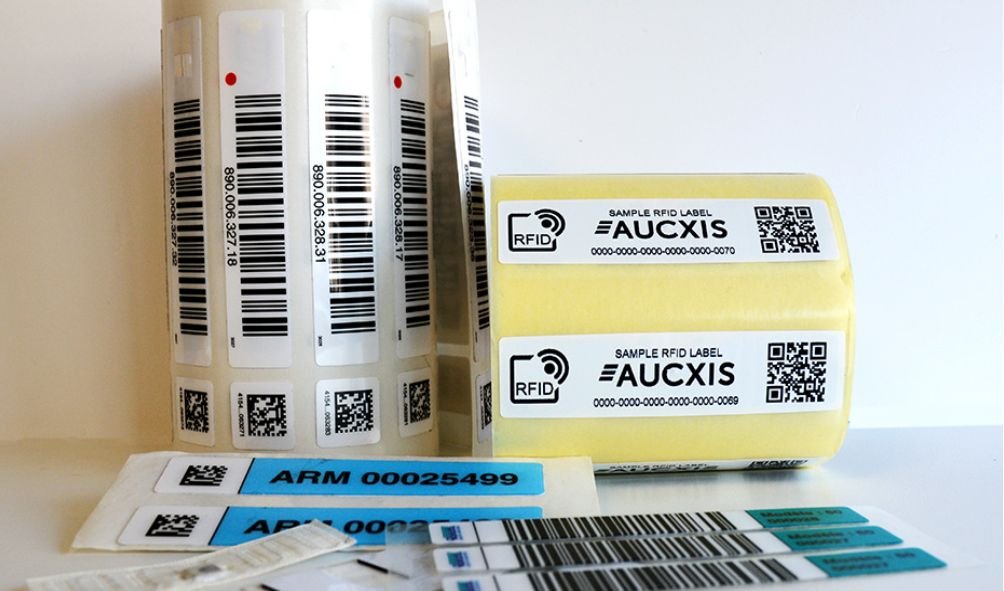
RFID tags are used extensively to design industrial machine labels, replacing traditional barcodes and tedious manual scanning procedures. RFID offers large data capture in real-time, without line-of-sight, and businesses can enjoy automated inventory and asset tracking solutions. RFID labels or tags are also called smart labels as they secure your inventory operations from human follies, asset loss, and the need for downtime.
Asset Tracking – RFID or electronic tags aid businesses to find and observe their assets in real-time. It offers continuous tracking to reduce the risk of loss and inefficient workflow. Many hospitals and medical centres use RFID custom machine labels to mark their medical machines and equipment. By fixing RFID readers near doorways, they are able to track the machine usage (last used). RFID technology is key to providing superior machine labeling solutions.
Inventory Management – RFID labels are essential to manage fixed inventory processes. These tags help track inventory stock precisely, minimising the risk of product loss. RFID labels, along with inventory management software, can make inventory procedures fully automated and 100% efficient. In the field of education, RFID tags can be used in libraries to track school textbooks; the librarian can literally scan innumerable books accurately without wasting time on manual barcode reading.
SCM – SCM or supply chain management can run smoothly using RFID technology. Businesses can be streamlined by using one or more tags for goods or containers. This can help track assets at all stages of the supply chain, assuring security and timely delivery. All crucial product data is naturally stored on the RFID tags, reducing errors, supporting authenticity, and minimising loss of assets.
Using barcode labels for machine parts in the automotive industry is a classic example. Most car manufacturers use RFID technology to monitor machine parts on their assembly lines. It becomes easy to find defective parts and their source. This quick process helps reduce the wastage of time otherwise spent in finding and fixing such issues. Businesses can thus save on costs, offer quality standards, and increase production.
System Access Control – RFID systems offer enhanced security and smooth operational support for thousands of businesses. RFID tags are powerful tools to gain access control, i.e. letting only reliable and authorized individuals enter strictly restricted areas. Companies use such tags to design employee ID cards to keep an accurate track of employee movement.
Even government bodies use RFID-enabled labels to enhance security and control access to highly restricted areas. When an RFID tag is scanned by the reader, the RFID system checks the user’s data and accordingly allows or denies access. Such technology can help secure confidential and sensitive data or resources, supporting an organization’s complete safety.
From improved asset tracking to value monitoring, recognising its beneficial features, RFID technology is used by a wide range of businesses including healthcare, retail, financial agencies, and government bodies. Reducing errors and eliminating manual mistakes, RFID asset tags are perfect tools for asset documentation. Similarly, unlike QR codes and barcodes, RFID tags are heavy duty labels that do not need a direct line of sight to initiate scanning. This quality makes it simpler to scan products without stressing about the correct position of the labels.
Other RFID technology benefits include extended read range (over 150 meters), simultaneous tag reading, i.e., the capability to read multiple tags at once, boosting efficiency and optimizing product tracking processes. Other special functionality of RFID-enabled tags includes features such as accurate temperature sensors for perishable items and sensitive products.
RFID technology is a critical tool in aiding modern ecosystems in 2026. It abets automation of labor, the elimination of manual errors, and real-time tracking. This system enables millions of businesses in India and abroad to gain a competitive edge through automation and data-driven processes.
You can reach out to established label platforms such as Prakash Labels, the leading RFID-enabled label manufacturer in India, to provide the most appropriate industrial and machine labeling solutions.
Can RFID tags be considered as waterproof labels for machines?
RFID tags are considered waterproof labels for machines when you select industrial-grade tags with IP67 or IP68 ratings. Normal paper RFID stickers cannot be used for machines.
What are 3 types of RFID tags?
The three primary RFID tags include:
Passive tags – These do not have internal batteries but read energy from the reader’s signal and transmit data. They are lightweight, affordable, and durable.
Active tags – Such tags have internal batteries, which allows them to send signals over distances up to many meters. It is useful for tracking expensive and heavy industrial machines.
Semi-Passive Tags – This tag uses an internal battery to manage the chip data, but also relies on the reader to interpret signals.
Can RFID tags be considered as one of the most suitable labeling solutions in manufacturing?
Yes, the RFID tags offer one of the most suitable labeling solutions in manufacturing. They provide more value over old traditional barcode systems as they enable bulk no-contact scanning minus direct line of sight. It enables real-time tracking, reduces errors, and improves productivity.
What is the main difference between traditional barcodes and modern RFID tags?
Barcodes need a direct line of sight and are scanned individually (one by one). RFID tags do not need a direct line of sight through covering materials. Hundreds of RFID tags can be scanned and read at once.
What do you mean by heavy-duty labels?
Heavy-duty labels are tough, durable, and reliable identification labels designed to withstand all kinds of extreme conditions. The best example is RFID-enabled tags.
Also Read: